The Contractor Profit Improvement Blueprint: 8 Steps to Recover 15-30% of Lost Profit
It’s Friday afternoon. You’re looking at your bank account, wondering how you just completed three successful projects—good work, satisfied clients, no major problems—but you barely have enough to make payroll next week. The jobs got done. The invoices went out. But somehow, the money just… disappeared.
You’re not alone. And it’s not your fault.
Here’s a sobering reality: 82% of construction businesses fail within their first 20 years. Even more disturbing? Most of these failures aren’t due to bad work, lack of demand, or inability to win bids. They fail because of invisible profit leaks—operational inefficiencies that bleed 15-30% of potential earnings from every single project.
This comprehensive guide reveals the 8 interconnected problems costing you thousands of dollars per project—and more importantly, shows you exactly how to fix them. By the end, you’ll understand where your profits are going and have a clear path to recovering them.
The Real Problem (And It’s Not What You Think)
Most contractors facing cash flow problems think they need to:
- Bid more jobs
- Raise their prices
- Cut labor costs
- Work longer hours
But here’s the truth: If you’re losing 15-30% to operational inefficiency, no amount of new work will solve the problem. You’ll just scale your losses.
Think about it this way: If you’re leaving $150,000 on the table annually due to poor processes, you’d need to win an additional $150,000 in revenue just to break even—and that new revenue will have the same inefficiencies built in.
The $950 Billion Crisis
The construction industry collectively loses nearly $1 trillion annually to eight interconnected operational problems:
- System fragmentation - $273 billion in redundant data entry and integration failures
- Financial visibility gaps - $189 billion from inaccurate job costing and pricing errors
- Receipt chaos - $47 billion in lost deductions and audit penalties
- Cash flow volatility - $156 billion in late payments and working capital shortfalls
- Compliance burden - $95 billion managing regulations, certifications, and documentation
- Estimating accuracy - $142 billion from bid errors and scope creep
- Resource coordination - $31 billion in scheduling conflicts and idle time
- Change order management - $17 billion in undocumented changes and disputes
You might recognize yourself in one or two of these categories. But here’s what makes this crisis so devastating: these problems don’t exist in isolation. They compound and amplify each other, creating what I call the “death spiral” of contractor profitability.
Why Fixing One Problem Isn’t Enough
You can’t just “get better at estimating” or “implement new accounting software” and expect to solve your profit problems. Each of these eight issues feeds into the others:
Poor financial visibility makes estimating harder. Bad estimates lead to cash flow problems. Cash flow problems force you to delay system improvements. System fragmentation makes visibility worse. And around it goes.
The contractors who succeed aren’t necessarily better at their trade—they’ve mastered the interconnected business operations that protect their profits.
Let’s examine each of these profit leaks in detail.
Profit Leak #1: System Fragmentation
Here’s What This Looks Like
You have QuickBooks for accounting. Procore or CoConstruct for project management. Your workers text receipt photos to your office manager. You track time on paper sheets or a separate app. Customer information lives in three different places. And every Friday, someone spends 6-8 hours manually entering data from one system into another.
Sound familiar?
The Real Cost
40% of construction workers’ time is spent on manual data entry and navigating between systems. For the industry, that’s $273 billion annually in pure waste.
For your business specifically, let’s do the math:
- 5 workers spending 8 hours/week on redundant data entry
- At $35/hour burden rate
- 52 weeks per year
- = $72,800 annually just in direct labor costs
That doesn’t include:
- Data entry errors that cascade through systems
- Delays in financial reporting
- Time spent troubleshooting “why these numbers don’t match”
- Inability to make real-time decisions because data is always 1-2 weeks old
Why This Happens
You didn’t set out to create a fragmented system. Each tool you adopted solved a specific, urgent problem:
- QuickBooks because you needed to do taxes
- Project management software when that big commercial job required it
- Time tracking app when workers’ hours got complicated
- Separate estimating software because QuickBooks couldn’t handle that
These tools weren’t designed to work together. Each one optimizes for its own narrow function while creating integration nightmares everywhere else.
As one contractor on ContractorTalk put it: “I have purchased a couple of expensive packages over the years only to find they don’t work as promised.” If you’ve felt this frustration, you’re not alone—and it’s not your fault.
Your Quick Win
Audit your current stack this week:
- List every software system you currently use
- Identify who uses each one and for what purpose
- Map how data moves between them (or doesn’t)
- Calculate the hours spent on manual data transfer each week
This visibility alone will help you identify your biggest integration bottleneck—the place where fixing one connection could save you 10+ hours weekly.
Profit Leak #2: Financial Visibility Gaps
Here’s What This Looks Like
Answer these three questions right now:
- Can you tell me your profit margin on last month’s completed jobs?
- Do you discover project losses only after completion?
- Do you trust your job costing reports enough to use them for bidding?
If you answered “no” to any of these, you have a financial visibility problem. And it’s costing you far more than you realize.
The Real Cost
Construction firms lose an average of $189 billion annually due to inaccurate job costing, pricing errors, and inability to track actual profitability in real-time.
Here’s how this shows up in your business:
Scenario 1: The “Profitable” Job That Lost Money You bid a kitchen remodel at $85,000. Three months later, you’ve collected payment and the client is happy. But when you finally reconcile all the costs:
- Actual labor: 15% over estimate
- Materials: 8% over due to price increases and change orders
- Subcontractor costs: You forgot to include the HVAC adjustment
- Equipment rental: Went two weeks longer than planned
Final margin: -3%. You lost $2,550—but didn’t know it until 60 days after completion.
Scenario 2: The Systematic Underpricing Without accurate historical job cost data, you’re bidding based on gut feel or outdated numbers. Research shows contractors systematically underprice by 11-18% when lacking real-time cost visibility.
On $1.2M in annual revenue, that’s $132,000-216,000 in lost profit—money you earned but didn’t capture in pricing.
Why This Happens
Financial visibility fails for three reasons:
- Delayed data entry - Costs aren’t logged until days or weeks after they occur
- Incomplete cost capture - Small expenses, worker time, equipment usage never get properly allocated
- No variance alerts - You only see overruns after they’ve compounded
Most contractors run their businesses on trailing indicators (what happened last month) rather than leading indicators (what’s happening right now on active jobs).
Your Quick Win
Implement a weekly WIP (Work in Progress) review:
Every Monday morning, for each active project:
- Compare budgeted costs to actual costs incurred to date
- Calculate estimated costs to complete
- Project final margin based on current trajectory
- Flag any job trending toward breakeven or loss
This 30-minute weekly habit can catch cost overruns while you can still do something about them—change the approach, have pricing conversations with clients, or reallocate resources.
Profit Leak #3: Receipt and Expense Chaos
Here’s What This Looks Like
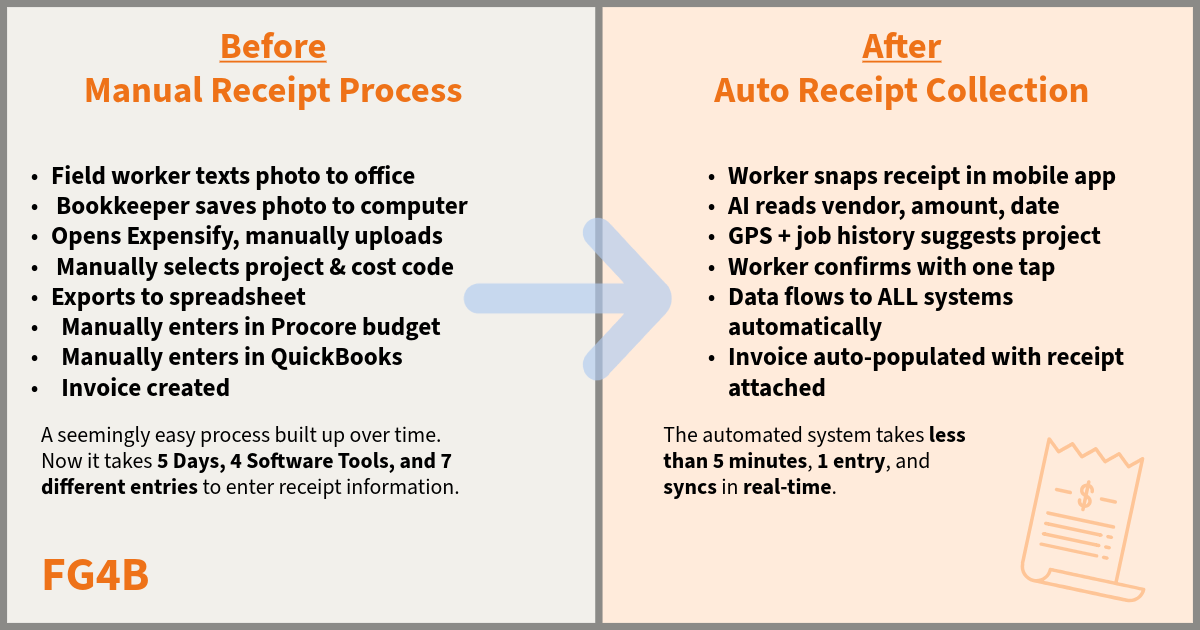
Your workers buy materials with their own cards and text photos of receipts. Sometimes. Other times they stuff crumpled receipts in their truck and you get them three weeks later. Or never.
Your office manager has a shoebox full of receipts that need to be categorized and entered. Half of them are illegible. A quarter are missing. When tax time comes, your accountant asks for documentation you can’t find.
The Real Cost
The industry loses $47 billion annually to:
- Lost tax deductions (unclaimed expenses)
- Audit penalties and interest
- Time spent recreating documentation
- Fraudulent expense claims that slip through
- Inability to track per-project material costs accurately
For your business, this typically shows up as:
Conservative estimate:
- $12,000-18,000 in unclaimed deductions (6-9% additional tax burden)
- $8,000-15,000 in time spent on receipt management
- $5,000-10,000 in undetected fraudulent/duplicate claims
- Total annual cost: $25,000-43,000
The Compliance Risk
Beyond the direct costs, there’s a bigger threat: IRS audit risk increases by 40% when expense documentation is inconsistent. In an audit, missing receipts mean disallowed deductions—and potential penalties of 20-75% on top of the additional tax owed.
One contractor shared: “We got audited and couldn’t substantiate $67,000 in material purchases. Cost us $18,000 in additional taxes plus penalties. All because receipts were in three different places and half were faded thermal prints.”
Why This Happens
Receipt chaos stems from three root causes:
- Decentralized purchasing - Multiple people buying materials across different vendors
- Delayed submission - No real-time capture system that works in the field
- Manual categorization - Someone has to look at each receipt and decide how to code it
Traditional solutions (save your receipts! use an envelope! take photos!) add friction to already busy workers and still require manual processing on the back end.
Your Quick Win
Implement a same-day receipt capture rule:
Starting next week:
- Any purchase over $50 requires receipt photo texted/emailed within 24 hours
- Create a dedicated phone number or email just for receipts
- Include job number and category in the message (“Kitchen Remodel - Lumber”)
- Friday = receipt roundup day; no exceptions
This won’t solve the full problem but will immediately reduce lost receipts by 60-80% and create accountability.
Profit Leak #4: Cash Flow Volatility
Here’s What This Looks Like
You just finished a $180,000 commercial project. The work is done, client is happy, but they’re on net-60 payment terms. Meanwhile:
- You have payroll in 5 days
- Material suppliers want their invoices paid (or they’ll cut off your account)
- That new excavator requires a monthly payment
- Another project needs $35,000 in materials ordered this week
Your accounts receivable shows $280,000 owed to you. Your bank account has $18,000. The money exists—just not where you need it, when you need it.
The Real Cost
84% of construction firms experience cash flow problems despite being profitable on paper. The industry collectively loses $156 billion annually to:
- Late payment interest and fees
- Lost early-payment discounts (typically 2-3%)
- Emergency high-interest financing
- Delayed equipment/technology investments
- Inability to take on profitable new work due to cash constraints
- Time spent managing collections instead of growing the business
For a mid-sized contractor doing $2M annually, this typically costs:
- $15,000-25,000 in lost early-payment discounts
- $8,000-12,000 in emergency financing interest
- $20,000-40,000 in projects declined due to cash constraints
- Total: $43,000-77,000 annually
The Compounding Problem
Cash flow volatility creates a vicious cycle:
- You need cash to start projects
- You bid jobs you can afford to start (not the most profitable ones)
- You accept client payment terms that hurt your cash position
- You can’t invest in systems/equipment that would improve efficiency
- Projects run less efficiently, eating into already-thin margins
- Cash gets tighter
- Repeat
As one contractor put it: “I’m turning down $500K in potential work because I can’t afford to carry the materials and labor costs while waiting for payment. I’m profitable but cash-starved.”
Why This Happens
Cash flow problems stem from three timing mismatches:
- Payment cycles - You pay suppliers in 30 days but collect from clients in 60-90
- Uneven revenue - Project-based work creates peaks and valleys
- Inadequate reserves - Most contractors operate with 2-4 weeks of cash runway (should be 12-16)
The standard advice—“just negotiate better payment terms” or “require deposits”—only works if you have leverage. Most contractors, especially when starting out, don’t.
Your Quick Win
Create a 13-week cash flow forecast:
This week, build a simple spreadsheet showing:
- Week-by-week projected cash in (by project, including payment terms)
- Week-by-week projected cash out (payroll, materials, fixed costs)
- Running cash balance
Update it every Monday. This gives you a rolling 90-day early warning system for cash crunches—enough time to secure a line of credit, adjust project scheduling, or have payment term conversations before you’re in crisis mode.
Profit Leak #5: Compliance and Regulatory Burden
Here’s What This Looks Like
You need to track:
- OSHA safety certifications for each worker
- EPA lead-safe certification for older homes
- State licensing renewals
- Insurance certificates for each project
- Prevailing wage documentation on public contracts
- DBE/MBE compliance for government projects
- Workers’ comp audits and documentation
- Building permits and inspection records
Each one has different renewal dates, documentation requirements, and filing systems. Miss one, and you’re looking at fines, project delays, or losing your ability to bid certain work.
The Real Cost
Construction firms spend an estimated $95 billion annually managing compliance, certifications, and regulatory documentation. For a contractor with 10-15 employees, this typically breaks down as:
- 120-180 hours annually on compliance administration
- $15,000-25,000 in certification and licensing fees
- $8,000-15,000 in penalties for late renewals or missing documentation
- $25,000-50,000 in lost opportunities due to inability to quickly prove compliance
The Specialty Contractor Multiplication
If you’re a specialty contractor (electrical, HVAC, plumbing), the burden multiplies:
- Trade-specific licensing (master electrician, HVAC certification, etc.)
- Manufacturer certifications for warranty work
- Specialized insurance (pollution liability, professional liability)
- Industry-specific training requirements
These credentials are your license to operate—but tracking them is an administrative nightmare that pulls you away from actual work.
Why This Happens
Compliance burden becomes overwhelming due to:
- Fragmented systems - Each certification tracked differently (spreadsheet, email reminders, paper files)
- Decentralized ownership - Multiple people responsible but no central visibility
- Reactive management - Only thinking about compliance when required for a bid or audit
Most contractors manage compliance through “heroic effort”—someone who just knows everything and keeps it in their head. When they’re sick or leave, the whole system collapses.
Your Quick Win
Create a compliance calendar this week:
Build a single spreadsheet with:
- Every license, certification, and insurance policy
- Expiration dates
- Renewal cost
- 90-day and 30-day renewal reminders
- Person responsible
Set calendar alerts for 90 days before each expiration. This simple system prevents 95% of compliance failures—the ones that happen simply because something fell through the cracks.
Profit Leak #6: Estimating and Bidding Accuracy
Here’s What This Looks Like
You walk through a property with the client, take some measurements, snap photos. Back at the office, you build an estimate based on:
- Your memory of similar jobs
- Current material costs (you think)
- Labor hours you estimate it should take
- A contingency buffer (usually 10-15%)
- Your gut feel about what the market will bear
You submit the bid feeling pretty good. Then one of three things happens:
Scenario A: You win the bid and lose money on execution Scenario B: You lose the bid to someone significantly cheaper (are they losing money?) Scenario C: You win, make money, but later realize you left $15,000 on the table
The Real Cost
The industry loses $142 billion annually to estimating errors:
- Underbidding and winning unprofitable work
- Overbidding and losing profitable opportunities
- Scope creep from vague estimates
- Change orders that should have been in the original scope
- Customer disputes over “what was included”
For your business, inaccurate estimating typically costs:
On underbids:
- 3-5 projects per year where margin evaporates
- Average loss: $8,000-15,000 per project
- Total: $24,000-75,000 in losses
On overbids:
- 40-60% win rate drops to 25-35% on competitive bids
- Each lost bid = $180-300 in estimating costs + opportunity cost
- Total: Hard to quantify, but potentially $50,000-150,000 in missed revenue
The Confidence Problem
Here’s a question: Do you trust your estimates enough to use them as budgets for managing projects?
Most contractors answer no. Their estimates are “good enough to win work” but not accurate enough to serve as operational budgets. This means:
- You’re bidding without really knowing if you’ll make money
- You can’t effectively track cost overruns during execution
- You have no reliable data to improve future estimates
Why This Happens
Estimating accuracy fails due to:
- No historical actuals - You don’t track what jobs actually cost vs. what you estimated
- Hidden complexity - Site conditions, access issues, and coordination challenges aren’t visible until you start
- Outdated unit costs - Material and labor rates change; your estimate template doesn’t
- Scope ambiguity - “Remodel the kitchen” means different things to you and the client
The contractors who consistently win profitable work have estimating systems, not estimating heroics. They know their numbers because they track them religiously.
Your Quick Win
Start a lessons-learned log:
For every completed project, spend 30 minutes documenting:
- What you estimated for major line items vs. actual costs
- What you missed or underestimated
- What took longer than expected and why
- What the client assumed was included but wasn’t in your scope
After 10 projects, you’ll have a pattern library of your most common estimating blindspots. This alone can improve accuracy by 15-25%.
Profit Leak #7: Resource and Schedule Coordination
Here’s What This Looks Like
Your master electrician is sitting in his truck waiting for the drywall crew to finish—they’re running 3 hours behind. Meanwhile, your plumber is on a different job that could have used your electrician’s help. Your framer is pulling a half-day because materials didn’t arrive when expected.
By day’s end:
- 12 labor hours paid for unproductive waiting time
- One crew working overtime to catch up (at 1.5x rate)
- Materials delivered to wrong job site (need to move them tomorrow)
- Customer calling asking why work hasn’t started on their project
The Real Cost
Poor resource coordination costs the industry $31 billion annually through:
- Idle time and unproductive labor
- Overtime to make up for scheduling failures
- Crew mobilization/demobilization waste
- Inefficient tool and equipment usage
- Rush material deliveries and expedite fees
For a contractor with 10-15 workers, this typically costs:
- 15-20% of labor hours are unproductive due to scheduling issues
- On $800K in annual labor: $120,000-160,000 wasted
- Plus overtime premiums: $15,000-25,000
- Plus rush fees and inefficiencies: $10,000-20,000
- Total: $145,000-205,000 annually
The Multi-Project Juggle
The problem multiplies when you’re running 4-6 concurrent projects:
You need Worker A on Project 1 Monday-Tuesday, Project 2 Wednesday-Thursday, and Project 3 Friday. But Project 1 runs long. Project 2’s permits get delayed. Project 3’s materials arrive early.
Now you’re constantly replanning, juggling, and putting out fires. Your workers get frustrated by the chaos. Your clients see inconsistent progress. And you’re working nights and weekends trying to coordinate it all.
As one contractor lamented: “I spend more time shuffling people between projects than actually managing the work. It’s exhausting.”
Why This Happens
Scheduling chaos stems from:
- Sequential dependencies - Trades must happen in order; delays cascade
- External dependencies - Permits, inspections, material deliveries, weather
- Optimistic planning - You schedule based on best-case scenarios
- No real-time updates - Schedule made Monday is obsolete by Wednesday
Most contractors manage this with whiteboards, group texts, and institutional knowledge. It works until it doesn’t—and when it fails, it’s expensive.
Your Quick Win
Implement a daily standup huddle:
Every morning, 15-minute call or meeting with crew leads:
- What got done yesterday vs. planned
- What’s planned for today
- What obstacles or delays are expected
- Who needs help or has capacity to assist
This simple ritual creates visibility and allows daily micro-adjustments instead of weekly firefighting.
Profit Leak #8: Change Order Management
Here’s What This Looks Like
Client: “While you’re here, can you also move that outlet?” You: “Sure, no problem.”
Two weeks later, you’re trying to reconcile job costs and realize you did 12 hours of extra work that never got documented, priced, or invoiced.
Or worse: You did document the change, told the client it would be extra, but never got written approval. Now they’re disputing the charge, and you have no leverage.
The Real Cost
Poor change order management costs the industry $17 billion annually through:
- Undocumented scope additions
- Disputed charges leading to write-offs
- Administrative time fighting over “what was agreed to”
- Customer relationship damage from pricing surprises
- Delayed invoicing and payment
For your business, this shows up as:
- 5-15% of project work is actually change orders
- On $1.5M annual revenue: $75,000-225,000 in changes
- You capture/invoice: 60-75% (the rest is written off)
- Lost revenue: $18,750-90,000 annually
Plus the relationship cost: Clients who feel blindsided by charges become your worst marketing—negative reviews and no referrals.
The “Good Customer Service” Trap
Many contractors avoid change order conversations because they don’t want to seem difficult or nickel-and-dime clients. So they eat small changes, thinking it builds goodwill.
Here’s the problem: One client’s “small change” is another’s “major addition.” Without consistent standards, you’ll inevitably upset someone—either by charging for something a previous client got free, or by eating costs that actually hurt your margins.
Why This Happens
Change order failures stem from:
- Verbal agreements - “Yeah, we can do that” without documenting scope or price
- Delayed documentation - Change happens Tuesday, paperwork happens Friday (if at all)
- Approval ambiguity - Did they actually agree to the price or just the work?
- Awkward money conversations - You’d rather do extra work than have a pricing discussion
The contractors who handle this well have standardized change order processes that remove emotions and awkwardness from the equation.
Your Quick Win
Create a change order template:
Simple one-page document with:
- Original scope reference
- Requested change description
- Additional cost and time impact
- Client signature/approval line
- Date
Keep a stack in your truck. Any time scope expands: pull out form, fill it out on site, get signature before proceeding. This takes 3 minutes and prevents 90% of change order disputes.
How These Problems Connect: The Death Spiral
Here’s what makes this crisis so insidious: these eight profit leaks don’t exist in isolation. They interconnect and amplify each other in a cascading failure pattern I call the “Contractor Death Spiral.”
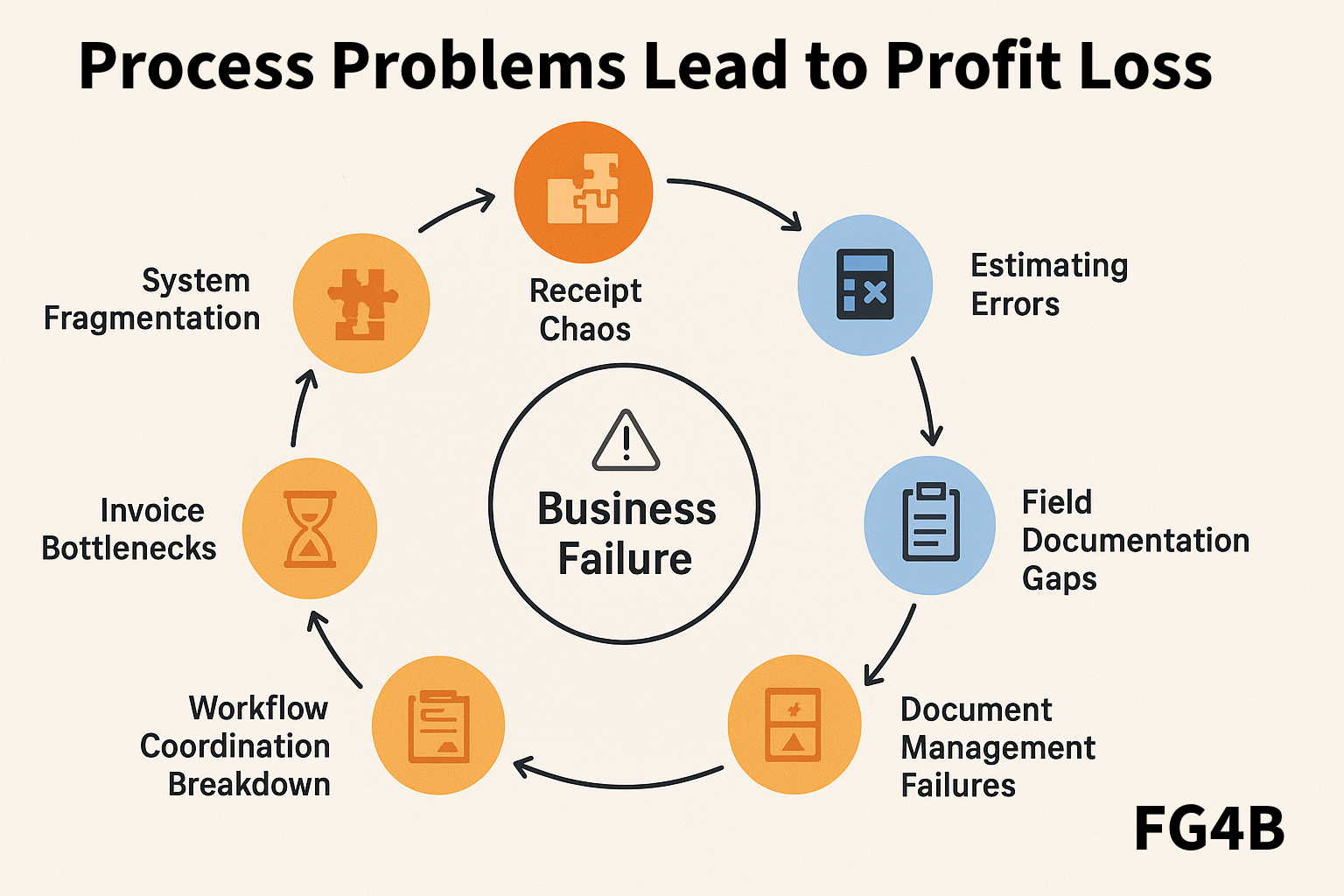
Let me walk you through a real scenario:
The Cascade
Month 1: Estimating Error You underbid a project by 12% due to poor historical cost data (Profit Leak #6). You don’t realize this yet because your financial visibility is weak (Profit Leak #2).
Month 2: Cash Flow Crunch The underbid project requires more material spend than anticipated. Combined with slow-paying clients, you hit a cash flow crisis (Profit Leak #4). You can’t afford the new project management software that would help with scheduling (Profit Leak #1).
Month 3: Coordination Chaos Running multiple projects with manual scheduling tools, you experience significant coordination failures (Profit Leak #7). Labor hours spike. Crews are waiting. Overtime adds up.
Month 4: Margin Erosion Untracked change orders (Profit Leak #8) and lost receipts (Profit Leak #3) mean you’re undercharging clients and overreporting income. The original underbid project finishes at a 6% loss, but you won’t know for another month.
Month 5: Compliance Penalty Distracted by firefighting, you miss a certification renewal (Profit Leak #5). You can’t bid on a profitable public project. You have to take a lower-margin private job instead to keep cash flowing.
Month 6: System Breaking Point Your bookkeeper quits because managing fragmented systems is overwhelming (Profit Leak #1). For three weeks, no financial data gets processed. You’re flying blind.
Month 7: The Reckoning When you finally get caught up on paperwork, you discover:
- Last quarter’s profit margin: 4% (you thought it was 12%)
- Three projects actually lost money
- You’re $47,000 short of where you thought you’d be
Now you’re in survival mode. You bid aggressively to generate cash (creating more estimating errors). You cut corners on systems and process. The spiral accelerates.
Breaking the Spiral
The good news: You don’t need to fix everything simultaneously. But you do need to understand how the pieces connect.
Contractors who successfully reverse the spiral follow a pattern:
- Fix financial visibility first - You can’t improve what you can’t measure
- Stabilize cash flow - Creates breathing room to invest in systems
- Systematize one high-impact area - Usually estimating or scheduling
- Build on momentum - Each improvement funds the next
The key is recognizing that isolated fixes won’t work. You need a systems-thinking approach that addresses root causes, not just symptoms.
Your Path Forward: Which Contractor Type Are You?
Not every contractor faces these eight profit leaks equally. Your business model, project types, and growth stage determine which problems hit you hardest—and therefore, where you should focus first.
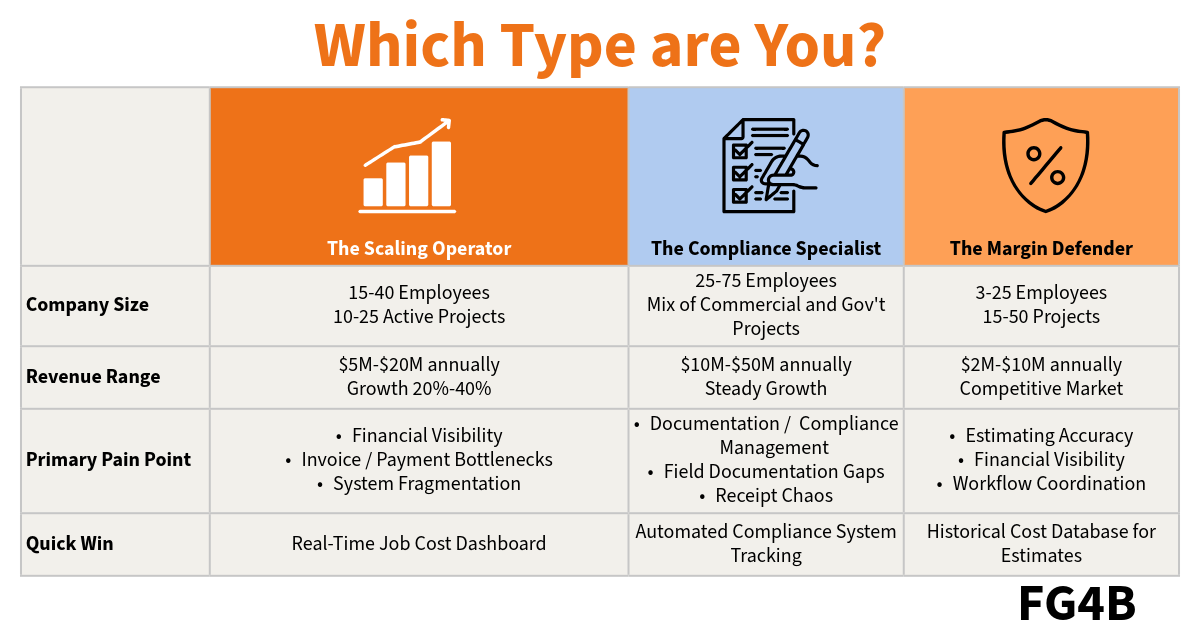
I’ve identified three distinct contractor personas based on thousands of conversations. Each faces a different priority order of these profit leaks.
The Three Personas
Persona 1: The Scaling Operator
- Profile: 15-50 employees, $3M-15M revenue, multiple concurrent projects
- Primary pain: Resource coordination (#7) and system fragmentation (#1)
- Why: You’re drowning in project juggling and manual processes don’t scale
- Secondary issues: Cash flow (#4), estimating accuracy (#6)
Persona 2: The Compliance-Burdened Specialist
- Profile: Specialty trade (electrical, HVAC, plumbing), 5-20 employees, heavy regulatory requirements
- Primary pain: Compliance burden (#5) and cash flow volatility (#4)
- Why: Certifications and prevailing wage requirements consume disproportionate time
- Secondary issues: Change orders (#8), receipt management (#3)
Persona 3: The Margin Defender
- Profile: 2-10 employees, $500K-3M revenue, high-end residential or niche commercial
- Primary pain: Financial visibility (#2) and estimating accuracy (#6)
- Why: Thin margins mean every estimation error or cost overrun is existential
- Secondary issues: Change orders (#8), system fragmentation (#1)
Which One Are You?
Quick Diagnostic Questions:
-
What keeps you up at night?
- “Managing multiple crews across projects” → Scaling Operator
- “Compliance deadlines and regulations” → Compliance-Burdened Specialist
- “Whether I’m actually making money” → Margin Defender
-
What would free up 10 hours per week for you?
- “Better scheduling and coordination tools” → Scaling Operator
- “Automated compliance tracking” → Compliance-Burdened Specialist
- “Real-time financial visibility” → Margin Defender
-
What’s your biggest fear?
- “Can’t grow without more chaos” → Scaling Operator
- “One missed certification tanks a big contract” → Compliance-Burdened Specialist
- “Working harder but making less” → Margin Defender
Recommended Starting Points by Persona
If you’re a Scaling Operator: Start with resource coordination (#7) and scheduling systems. Quick wins:
- Daily standup huddles (immediate)
- Shared scheduling system (week 1)
- Clear project handoff protocols (week 2-3)
- Integrated project management platform (month 2-3)
If you’re a Compliance-Burdened Specialist: Start with compliance calendar (#5) and cash flow forecasting (#4). Quick wins:
- Compliance tracking spreadsheet (immediate)
- 13-week cash flow forecast (week 1)
- Client payment term negotiations (ongoing)
- Automated renewal reminders (month 1)
If you’re a Margin Defender: Start with financial visibility (#2) and estimating systems (#6). Quick wins:
- Weekly WIP reviews (immediate)
- Lessons-learned log (week 1)
- Historical cost database (month 1-2)
- Real-time job costing dashboard (month 2-3)
Taking the First Step: Your 30-Day Action Plan
You don’t need to fix everything at once. In fact, trying to tackle all eight profit leaks simultaneously is a recipe for frustration and failure.
Instead, commit to one high-impact improvement per month. Here’s your roadmap:
Week 1: Diagnose Your #1 Profit Leak
Monday: Read through the eight profit leaks again and rank them by impact on your business (1-8, where 1 = biggest problem)
Tuesday-Wednesday: Quantify your top three:
- How many hours per week does this cost you?
- How much money (lost revenue, wasted costs)?
- What opportunities are you missing because of it?
Thursday: Identify which persona you most closely match
Friday: Choose ONE profit leak to address this month (usually your #1 or #2)
Week 2: Implement Your Quick Win
Each profit leak in this guide includes a “Quick Win”—a specific action you can implement in 1-7 days. This week:
Monday: Review the Quick Win for your chosen profit leak
Tuesday-Thursday: Implement it
- Build the spreadsheet
- Create the process
- Set up the system
- Train your team
Friday: Measure baseline metrics so you can track improvement
Week 3: Build the System
Quick wins create immediate relief, but systems create lasting change. This week:
Monday-Tuesday: Document your new process
- What’s the step-by-step workflow?
- Who’s responsible for what?
- When does it happen?
- What tools/templates are needed?
Wednesday-Thursday: Create accountability mechanisms
- Who checks that it’s being followed?
- What metrics indicate it’s working?
- How often do you review and refine?
Friday: Run your first formal review of the new system
Week 4: Plan Your Next Move
Monday: Assess the impact of your first improvement
- Time saved?
- Money saved/recovered?
- Stress reduced?
- New capabilities unlocked?
Tuesday-Wednesday: Identify your #2 profit leak to address next month
Thursday: Research tools, training, or support you might need
Friday: Commit to your Month 2 improvement
The Compounding Effect
Here’s what happens when you fix one major profit leak per month:
- Month 1: Recover 3-5% of leaked profits
- Month 2: Recover another 3-5% (now 6-10% total improvement)
- Month 3: Earlier fixes start compounding; recover 4-7% more (now 10-17%)
- Month 6: You’ve addressed half the profit leaks and recovered 15-22% of lost profits
On $1.5M in annual revenue at a target 20% margin:
- Before: Actual margin 8% = $120,000 profit
- After 6 months: Actual margin 20% = $300,000 profit
- Recovered: $180,000 annually—without doing more work or raising prices
Get Personalized Support
15-Minute Workflow Assessment Book a quick call where we’ll:
- Review your specific profit leak situation
- Identify your highest-impact starting point
- Map out a 90-day improvement roadmap customized to your business
No pitch, no pressure—just clarity on your next steps.
Join the Community
You’re not alone in this. Thousands of contractors are working to protect their profits from these same eight leaks.
Weekly Office Hours: Every Thursday, I host live Q&A sessions where contractors share what’s working, troubleshoot challenges, and learn from each other’s experiences.
Monthly Deep Dives: First Tuesday of each month, we tackle one profit leak in depth with case studies, implementation templates, and group problem-solving.
Join the Contractor Profit Mastery Community →
Final Thoughts: The Business You Deserve to Build
You didn’t get into construction to manage spreadsheets, chase receipts, or juggle scheduling conflicts. You got into it because you’re skilled at your trade, you take pride in quality work, and you saw an opportunity to build something of your own.
But here’s the truth: craft excellence doesn’t automatically translate to business profitability. The contractors who thrive aren’t necessarily the best framers, electricians, or finish carpenters—they’re the ones who’ve mastered the business operations that protect their profits.
The $950 billion crisis affecting the construction industry isn’t about lack of work or skilled workers or market opportunity. It’s about the cumulative weight of eight interconnected operational problems that slowly bleed profitability until there’s nothing left.
You now know what they are. You know how they connect. You know where you fall and where to start.
The question isn’t whether these problems exist in your business—they do. The question is: What are you going to do about it?
Start with one. Fix it properly. Build on that momentum. Six months from now, you could be recovering 15-30% of your current profit leakage—that’s potentially $50,000, $100,000, or even $200,000+ back in your pocket annually.
Same amount of work. Same quality standards. Same business—just properly protected profits.
You deserve to make money commensurate with the value you create. The path forward is clear. The tools are available. The only question left is: Are you ready to start?
About FG4B
FG4B helps contractors recover lost profits through workflow automation and operational excellence. We specialize in translating complex construction operations into integrated systems that actually work—without requiring a computer science degree to operate.
Our approach is simple: Understand your specific profit leaks. Implement targeted solutions. Measure real results. Rinse and repeat.
We’re not selling software or promising overnight transformation. We’re offering proven frameworks, practical tools, and expert support to help you systematically eliminate the operational inefficiencies costing you 15-30% of your potential profits.
Ready to stop leaving money on the table? Let’s talk.
Schedule Your Free Workflow Assessment →